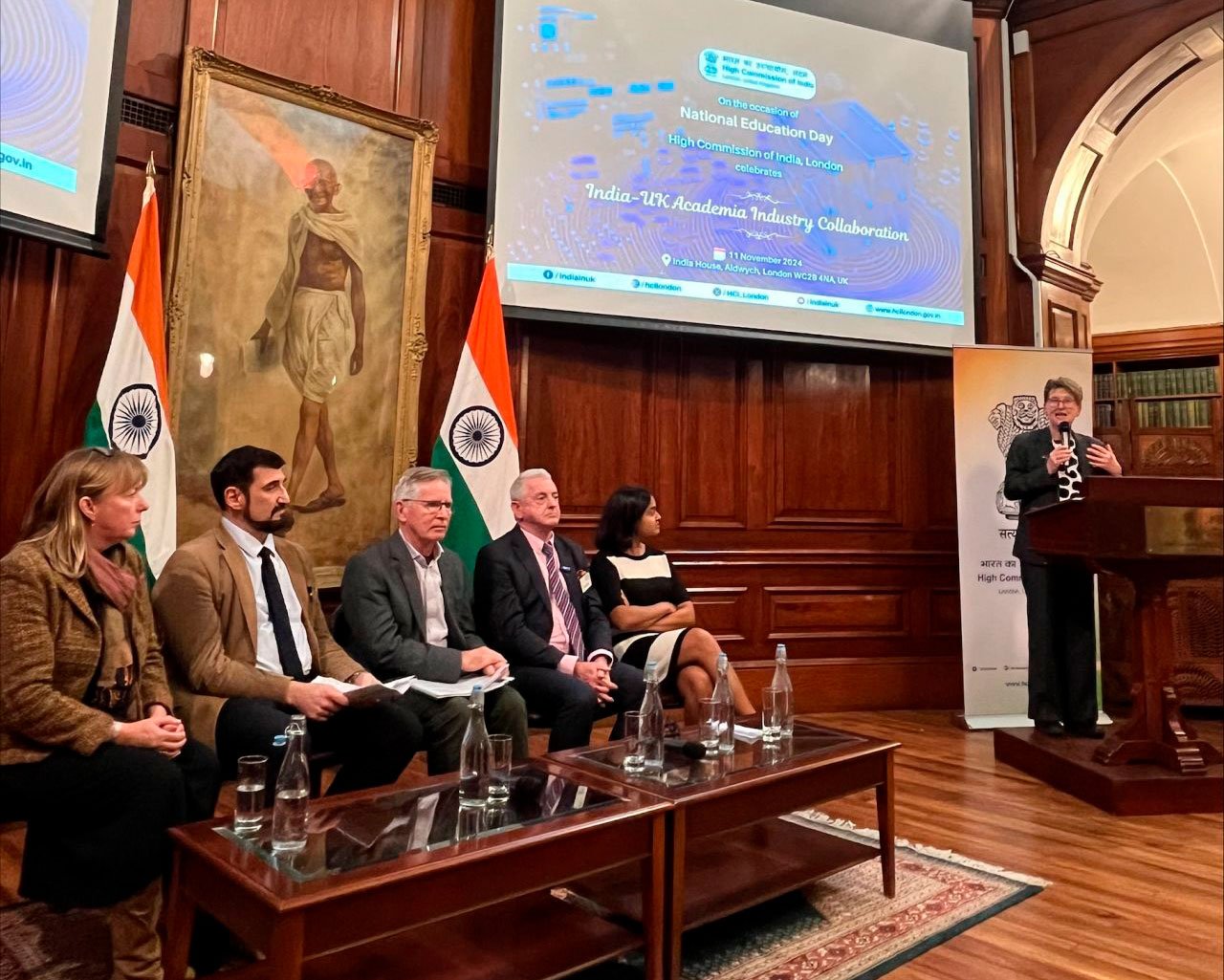
The UK-India Future Networks Initiative (UKI-FNI), sponsored by the UK Engineering and Physical Sciences Research Council (EPSRC), has been supporting cutting-edge research into next-generation telecoms, exploring innovations in the technologies required for connectivity and services for future telecoms networks. The UKI-FNI project, collaborating with scientists, policy makers and engineers in UK and India, has also helped shape a joint vision and research strategy for the future integration of terrestrial and non-terrestrial telecoms networks, covering 6G, optical, sub-sea and satellite systems and their security management in support of Network-enabled AI Services.
Led by Prof Gerard Parr of the University of East Anglia (UEA) in Norwich UK, the initiative brings together leading researchers from University of Surrey, University of Southampton, University College London, and King’s College London, alongside key partners from the Indian Institute of Science (IISc) Bangalore and the Indian Institute of Technology (IIT) Delhi. The UKI-FNI Team have recently engaged with the Bharat 6G Alliance and Voice of Indian Communication Technology Enterprises (VoICE).
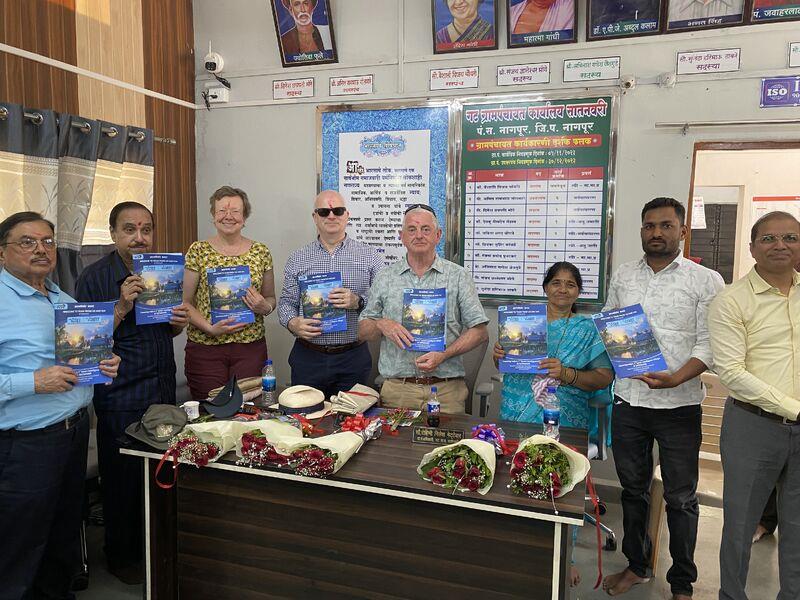
On 15-16 April 2026, the UKI-FNI team consisting of Professor Gerard Parr, Professor Steve Hailes & Professor Helen Hailes visited Satnavari Smart Intelligent Village Project. During their 2-day visit, the delegation observed a range of technology deployments and interacted with users. Detailed discussion with the village Gram Panchayat team along with VoICE team was done at Satnavari Panchayat office.
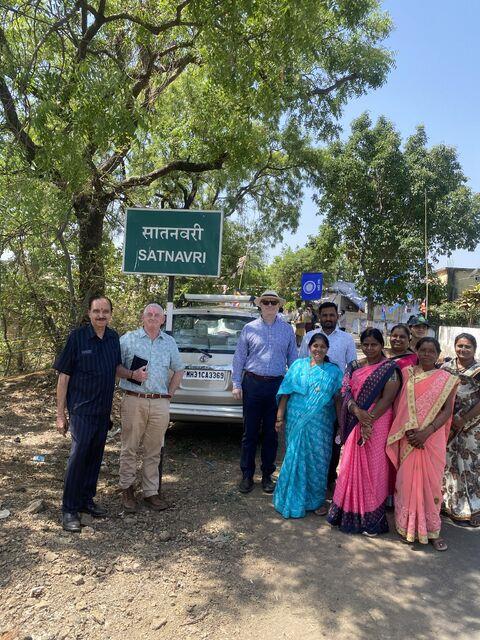
Professor Gerard Parr commented after conclusion of delegation’s visit to Satnavari:
- A world-leading example of digital technology having real local impact.
- I was privileged that members of our EPSRC UK-India Future Networks Project (led by University of East Anglia) were able to visit Satnavari, a remote village of 1800 people located near Nagpur, Maharashtra.
- It is recognised as India’s first “smart intelligent village”, transforming rural living through technology. It features AI-driven solutions for surveillance, healthcare, and sustainable development, bridging the gap between urban and rural amenities. It serves as a model for modern, connected rural communities.
- Worthy of particular mention is that this initiative has been developed without any grants or tax-payer funds to date.
Key Features of Satnavari Smart Village:
Technology & Connectivity: Enhanced digital infrastructure includes high-speed Internet, allowing for smart connected services, with local free access to the Internet and Satellite connectivity to remote stations.
- The latter was the basis of a recent Telemedicine demonstration between the village and the UKI-FNI Team along with others in December 2025
- *Safety & Infrastructure: The village incorporates AI-powered surveillance for enhanced security and modern amenities aimed at improving quality of life.
- *Sustainability & Health: Focuses on energy-efficient solutions and improved healthcare facilities to cater to the needs of residents.
- *Rural Development: Acts as a pilot for integrating, “smart” technologies into rural landscapes to foster economic and social growth. This includes use of drones for crop spraying, IoT sensors for soil health detection and water quality management for agriculture and human consumption.
- Other use-cases include deployment of low cost IoT sensors to detect the health of water in a local fishing lake and also apps to monitor the health of cows in the village and provide real-time data feeds to local farmers.
- It is also a model of digital transformation in rural villages that is helping to empower women to start new businesses.
- It was fantastic to be able to meet the key people behind the Satnavari Smart Village initiative, especially the villagers themselves who are helping to define the requirements for the use-cases that have been developed.
- Exciting plans exist to use this Satnavari Smart Village as a model to be rolled out to 75 further villages in the region and a further 4000 plus villages later.
- This is a model for the world and I am delighted and privileged that our UKI-FNI Team are engaging to explore how we can collaborate further.
- We also participated in a launch of a Technical Briefing Note in celebration of our visit.
- Having seen pathbreaking work done by VoICE team in Consortium model, Professor Gerard Parr and his delegation along-with Governing Council of VoICE consortium agreed to collaborate and sign a Memorandum of Understanding.
Speaking of the collaboration between UK-FNI and Voice, Professor Gerard Parr PI of the UKI-FNI project commented:
“The UK-India Future Networks Initiative leverages a long track record of collaboration in Digital Technologies and Telecoms going back 20 years. It is now well recognised that 6G, Optical and Satellite Communications are strategically important to supporting the digital applications and services that the economy and wider society of India and the UK depend upon. The importance of Non-Terrestrial Communications has gained increasing attention in recent years where satellite connectivity can provide for greater spatial coverage and Internet access across rural and remote areas direct to hand-held devices and fixed-mobile sensors in connected vehicles, supply chain objects, etc. I am delighted and excited to be working with our partners in India and look forward to developing future collaborations”
Satnavari is at the forefront of India’s rural digital transformation programme and was selected under a Maharashtra state-backed pilot project to become the nation’s first ‘Smart Intelligent Village’. The initiative integrates advanced technology into daily rural life, covering agriculture, education, healthcare, governance, and finance. This project reflects a new model for holistic rural development using modern digital tools.
Speaking on the collaboration, Rakesh Kumar Bhartnagar, Director General of VoICE, the consortium of Indian Communication-Technology enterprises stated:
“VoICE (Voice of Indian Communication Technology Enterprises) is a consortium formed in 2022, to bring together all the small, medium, and large Indian telecom companies to drive technology adoption and build self-reliant (Atma Nirbhar as called in India) telecom ecosystem. VoICET LLP is also registered for supporting developments beyond the Pilot Project at Satnavari.
Today the VoICE consortium has been able to develop Satnavari village in Maharashtra, India into a model village using Bharatnet OFC bandwidth, latest 4G/ 5G/ NTN indigenous technologies to upgrade lives across village administration, health, education, last mile transportation, agriculture and create a sustainable economy, and realise the vision of the Sustainable Development Goals of ITU & UN. With technology-driven higher income opportunities in the villages, the migration of people from villages to cities can reduce and we can retain the unique cultural ethos of the village to move to the next generation.
The focus is not only on Bharatnet OFC bandwidth and cutting-edge technology like satellite and 4G/ 5G, but also on the creating a sustainable, self-maintained ecosystem within the Satnavari village, all contributed by various small and medium scale companies and complimented by the maintenance by the villagers is the perfect model to be spread globally across similar village ecosystems in Africa, South America, Asia and other parts of the world. I believe this Satnavari model is a successful model to be spread across the world for a sustainable telecom-driven ecosystem.”
It was an honour for the VoICE team to host the UK team led by Prof Gerard at first Global Smart Intelligent Village implementation at Satnavari, Nagpur Rural on 15 and 16 April 2026 with 18+use cases covering the ITU-T Recommendation Y.4218 also in the process. In spite of being very hot with a temperature touching 43 degrees, the team was ready to walk in the fields so that all details were noticed. Support from Satnavari Panchayat, Nagpur team of Maharashtra including Secretary to Chief Minister and Mayor, Nagpur and other seniors also in honour of the foreign delegates and VoICE Consortium team was very touching.
This has given confidence to VoICE team to plan for the next 75 Gram Panchayats in Sindhudurg, Hingoli, Pune, Amravati and Nagpur. We have offered our support for Nashik Kumbh, Smart Temple Mata Sati Anusuya Katol temple, portable primary health centre, 5G enabled fishing in oceans and multi-currency supporting Bank on Wheel, support for digital divide and digital infrastructure support for Slum areas of Smart cities like Nagpur. Live showcasing of blood samples taken, placed in the diagnostic unit of VoICE at Satnavari and test results being available in record less than 10 minutes and being available on screen and shared on WhatsApp was the big surprise for UK team who indicated that similar test results could have taken 5 days in UK if processed between a GP Surgery and a local hospital.
The strength of our Consortium based mode and time taken for implementation between 19 June 2025 and inauguration on 24 August 2025 for 18+ use cases simply astonished the UK team. I had made a presentation to ITU-T also on 25th March and it was the first Global implementation of Smart Rural Community as visualised in ITU-T Recommendation Y.4218.
About Smart Intelligent Village at Satnavari by Voice of Indian Communications Entreprises in partnership with Government of Maharashtra
The Smart Intelligent Village Project was first conceptualised by Director General, Voice along with DoT and on 10th July 2024 a full one-day workshop was organised at Pusa Agriculture University with inauguration by Secretary Telecom, Government of India and participation from Service providers, industry, and government. Reference for the project was ITU-T recommendation Number Y.4218 on Smart Services in Rural Communities Villages.
Based on aforementioned consultation with stakeholders and in partnership with Maharashtra state Government, The VoICE team took up the initiative to establish a Smart Intelligent Village pilot project with its own funding at Satnavari village, Nagpur rural, Maharashtra. The Project was inaugurated by H.E. Shri Devendra Fadnavis, Chief Minister, Maharashtra on 24th August 2025.
Smart Intelligent Village project is using IoT and AI enabled/ready devices covering agriculture, healthcare, Education, etc. Project is harnessing potential of IoT devices and Artificial Intelligence for Smart Use Cases providing services starting from passive infra and Wi-Fi mesh for RF connectivity. Successful trial runs have been conducted for deployment of Private network, Satellite network, Public 4G/5G network and Government owned BharatNet Fibre. Network
connectivity is used for connecting various devices for agriculture diagnostics, irrigation management, water health diagnostics, cattle health diagnostics, medical diagnostics for villagers & remote medical advisory with prescriptions, providing internet cast educational services to the village students, measuring Soil health, NPK level, Drones for fertilisers & pesticide spraying. These solutions are delivered by 25 small companies under VoICE consortium.
VOICE has been spearheading its mission for facilitating the homegrown technologies built by Small Indian Companies, in contributing to the Industry & Society effectively for holistic and sustained growth.
The PoC Project was inaugurated by honourable Chief Minister along with other dignitaries on the 24th August 2025 and is under continued observation for sustained performance. Village has experienced transformative benefits of IoT and AI powered solutions and have seen wider adoption amongst all sections of rural communities. Looking at the sustained benefits for rural communities, Maharashtra Chief Minister has already announced transformation of 3580 villages as Smart Intelligent Villages in the first phase and initially 75 AI Smart Villages are being covered spread over 5 Talukas in 5 Districts
The Government of India Department of Telecom (DoT) is taking up the initiative for the coverage across the rural communities in India and VoICE team has already made some presentations to the Department of telecom, Government of India and more will follow in coming days.
Summary of our Intentions
The intention of both parties is to share insights in the research, innovation, technology development, technology trials, standards-based telecommunications technology and IoT, ecosystem, leveraging each other’s experience for deployment of Smart Technologies and to work together for their mutual benefit. Furthermore, the parties may seek to encourage collaborative activities in various ways, including the exchange of best practice ideas and expertise.
Some Reference Links
- UK-India Future Networks Initiative: https://www.ukifni.org/
Contact- Professor Gerard Parr (g.parr@uea.ac.uk) - VoICE: https://voiceofindiancomm.com &
- VoICET: https://voicetllp.com & https://voicet.instagrp.in/
- Android application on Smart Intelligent Village available on:
Play store Link: https://play.google.com/store/apps/details?id=com.instagrp.voicet
Demo Credentials: (ID: 0000000000 & Password: 000000) - Satnavari Smart Village: https://villagesquare.in/satnavari-village-smarter-than-most-indian-cities/