UKI-FNI Pilot Project Phase II – Summaries
7th February 2025
The second group of Pilot projects to be funded by the EPSRC UK-India Future Networks Initiative have been selected to address technical, engineering and business challenges of designing and building future telecommunications infrastructure.
Pilot Project Summaries
 Feasibility Study of Quantum-based Digital Twin Concept for Security Enhancement in Open RAN (Q-DTRAN)
London Digital Twin Research Centre (Middlesex University) (Lead Partner), Rakuten Symphony, HCL Technologies
Professor Huan X. Nguyen, Middlesex University, Email: H.Nguyen@mdx.ac.uk
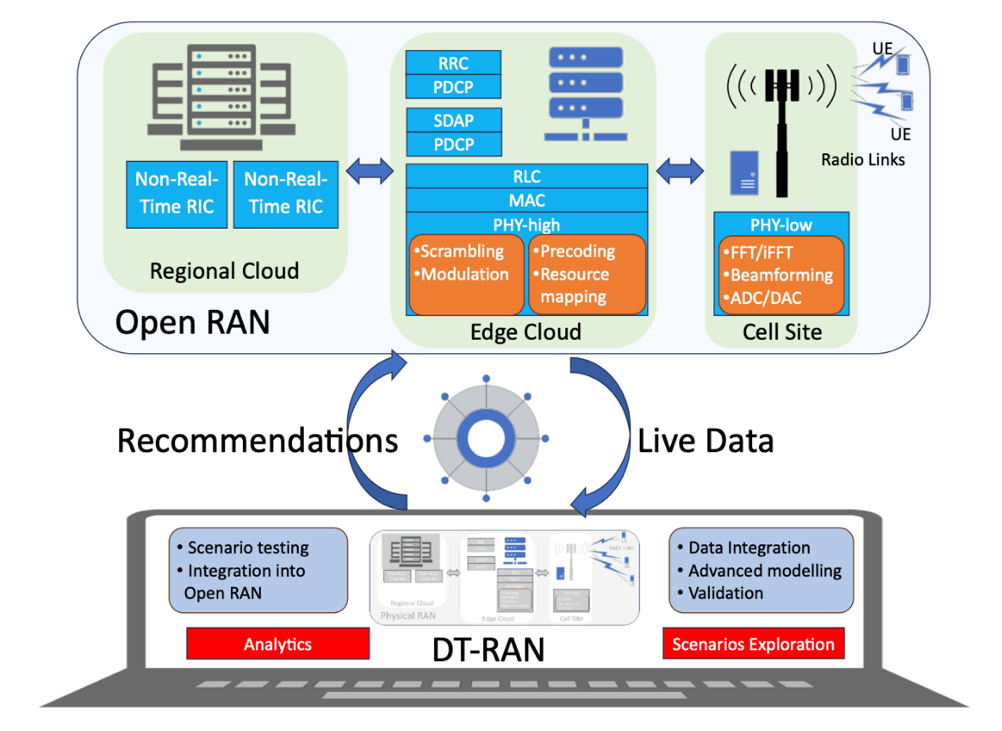
The future of wireless systems beyond 5G and 6G demands dynamic and adaptable architectures to support diverse applications with varying quality requirements, such as throughput, latency, and reliability. Open Radio Access Network (O-RAN) offers the flexibility to orchestrate resources on demand but introduces increased complexity and an expanded attack surface, creating significant security challenges. The evolving threat landscape and lack of standardised security protocols amplify these vulnerabilities, highlighting the need for innovative solutions. This pilot project explores the concept of using Digital Twin (DT) technology to enhance the security of O-RAN systems for 6G networks. DTs replicate physical network components in a virtual environment, enabling real-time monitoring, simulation, and optimisation without interfering with live systems. The project aims to study the challenges in real-time data handling and complex modelling of DTs and potential solution domain of integrating Quantum Computing (QC) into the DTs to optimise security configurations dynamically and efficiently.
Collaborators: With a multidisciplinary consortium of UK and Indian partners, including the London Digital Twin Research Centre, Rakuten Symphony, HCL Technologies, and several leading universities, the project will investigate the feasibility of linking DT and QC concepts to address O-RAN security challenges and establish pathways for future implementation and validation on real-world testbeds.
 Energy Efficiency Evaluation Framework for O-RAN (E3FORAN)-Part II
James Watt School of Engineering (University of Glasgow) (Lead Partner), Indian Institute of Information Technology, Kottayam (IIIT Kottayam), India
Dr Oluwakayode Onireti, University of Glasgow, Email: Oluwakayode.Onireti@glasgow.ac.uk
Energy efficiency remains a critical challenge in Open Radio Access Networks (Open-RAN), necessitating empirical validation and benchmarking against traditional RAN architecture. The second phase of the E3FORAN project focuses on quantifying and comparing the power consumption of Open-RAN and legacy systems (RAN) to drive sustainable network design. Key technical objectives include:
- Benchmarking power consumption of Open-RAN components (Central Unit, Distributed Unit, Radio Unit) under varying traffic loads using the University of Glasgow’s Open-RAN testbed
- Empirical measurement of traditional RAN power consumption via the university’s 5G Nokia testbed to establish baseline comparisons.
- Evaluating energy efficiency across different Open-RAN functional split options (e.g., 7.2x and traffic dynamics).
- Validating theoretical models from Phase I against real-world data and state-of-the-art benchmarks to identify optimisation opportunities.
- Disseminating actionable insights to academia, industry, and standardisation bodies (e.g., O-RAN Alliance) through workshops, conferences, and technical demonstrations.
Collaborators: The project leverages standardised methodologies (e.g., ETSI ES 202 706) and collaboration between the University of Glasgow, UK, and the Indian Institute of Information Technology (IIIT) Kottayam, India. Outcomes aim to guide telecom operators in adopting energy-efficient Open-RAN deployments, influence global standardisation efforts, and lay the groundwork for sustainable 6G networks. Dissemination activities include presentations at IEEE conferences, workshops at partner institutions, and engagement with policymakers to maximise academic, industrial, and societal impact.
 Transforming Real-Time Teleoperation of Robotic Systems in Hazardous Environments with Advanced Wireless Technologies
Communication Sensing & Imaging Hub (University of Glasgow) (Lead Partner), Indian Institute of Technology Delhi (India) and Indian Institute of Technology Bhilai (India)
Professor Qammer H. Abbasi, University of Glasgow, Email: Qammer.Abbasi@glasgow.ac.uk
The project aims to revolutionize real-time teleoperation of robotic systems in hazardous environments by leveraging the integration of Open Radio Access Networks (Open-RAN), Reconfigurable Intelligent Surfaces (RIS), and adaptive beamforming. Focusing on overcoming wireless communication challenges for 5G and beyond, the project seeks to develop ultra-low latency and reliable connectivity for robotics in applications such as disaster response, healthcare, and manufacturing. Key research will investigate the synergy between Open-RAN and RIS to optimize network resources, ensuring robust, mission-critical wireless systems that deliver minimal latency and maximum resilience for real-time robotic operations.
Collaborators: Indian Institute of Technology Delhi (India) and Indian Institute of Technology Bhilai (India)
 5G Standalone Private Networks – RFSoC Enabled Radio Designs
Strathclyde Software Defined Radio Lab (StrathSDR) (University of Strathclyde) (Lead Partner), Indian Institute of Information Technology (IIIT), Madras (IITM) in Chennai, India
Professor Robert W. Stewart, University of Strathclyde, Email: r.stewart@strath.ac.uk
Spectrum is the key ingredient in any radio frequency (RF) communications. Quite simply, no show without spectrum! In recent years a number of countries have setup shared access bands with either dedicated shared spectrum or rules to allow licenced spectrum for mobile network operators to be shared. In the spirit of sharing, the 6GHz band presents a new opportunity for hybrid access and sharing of both Wi-Fi and 5G. In this project, the partners will engineer operational RFSoC (Radio Frequency System-on-Chip) based gNodeB radio designs to create 6GHz testbenches for 5G SA for interoperability testing with Wi-Fi solutions.
Collaborators: Investigators from the University of Strathclyde, in Glasgow, UK, and the Indian Institute of Information Technology (IIIT), Madras (IITM), in Chennai, India will work with international partners including AMD and Cisco on operational design and blueprint for 6GHz 5G SA solutions.
PARTNERS